For Whom Did You Carry the Rock?

“For whom did you carry the rock?”

It’s a strange question, I admit, but it’s one I’ve been asking myself nearly every day since I read Betty’s biography.*

The question, and all its versions, (“but why did you carry that stone in the first place, Abi?”) has followed each time I’ve felt a twinge of entitlement or bitterness or like anyone owes me anything.

Why does this rock question carry meaning?

A young woman named Betty felt called to the mission field. She poured every ounce of her life’s passion into an isolated group, the Colorado Indians in Ecuador. The harvest was plentiful, but she stood in the gap as one of the few laborers studying the culture and the languages (actually, two of them).

After a long nine months of harvesting meticulous translation notes, she received word that all of her documents had been stolen along with her luggage. She never saw them again, and her observations would never birth a single resource, let alone a Bible translation.

Why would God waste the work of such a rarity — a talented Scripture translator willing to use her gifts for however long it took to reach an isolated people group? It was His gospel after all. Betty stared at the undressed truth that God’s sovereignty transcends what looks like efficiency to us. To her, it seemed like a storm without any rainbow, but God wove a fruitful plan for the woman who became Elisabeth Elliot. 

Due to this experience with the Colorado people and what many would assume a “wasted year” in the jungle, Elisabeth Elliot was impacted by an apocryphal story (so it’s not Scripture), and now it haunts me too. It reminds me nothing done in the service of God is truly wasted, even when we are left confused by the results of our efforts.

Here is the “lovely little African legend about Jesus,” that Elisabeth Elliot said, “hit her between the eyes.” Jesus and his disciples summited a mountain and along the journey he asked them each to pick up a stone. John chose a large one, Peter a small one.

When they got to the top of the mountain, Jesus turned both stones into bread. Peter, of course, regretted choosing a small rock. Later, again Jesus asked Peter and John to pick up stones. This time, Peter found the largest stone he could muster. At the end of their day’s journey, Jesus brought his disciples to the edge of the water. There they were commanded to cast their stones into the water. Peter protested, thinking about the bread he’d hoped for, and his teacher answered, “For whom did you carry the rock?”

This story resonated with me because I carry various stones in ministry and my motives can fluctuate. Sometimes I choose the size of effort based on the give-and-take I think I’ll receive.

Why did I carry the rock? What if God never does anything with it? Or maybe He’ll turn it into bread I’ll never taste? Why did I mentor another believer? Why did I help with moving? Why did we share the gospel with our neighbor over and over and serve her until her dying breath, when she never seemed to turn to her Maker? Why am I in ministry at all? Did I carry that rock so I could have something for myself? Surely, God would reward His faithful servant. Why did we go on that rabbit trail of resources, training, and immersion in a culture? Is it a waste if God seemingly cuts the season short? If my marathon preparation never meets the race I expected?

God doesn’t work according to our measures of efficiency. Yet He never wastes. As soon as we recognize this, we’ll cease striving and spewing about what doesn’t feel logical or fair. Instead, our very purpose is “to the praise and glory of God’s grace,” and we rest all of our labor with the Chief Cornerstone who declares, “I will build my church” (Matt. 16:18).

We carry these rocks in obedience because He is good, because He can be trusted, and because He is worthy. Because God is good and big enough to hold something even as precious as the destiny of the Colorado Indians. He can hold even our unanswered questions.  

If we’re doing His work for something other than God’s glory, we should get out now. Those are only the motions, and He doesn’t want empty lip service when our hearts are far from Him (Is. 29:13).

It’s a joy to invest in friendships with those delightful, easy-to-love souls who share our sense of humor, and enjoy talking about the same things as us. We’re eager to pursue vibrant personalities who also love to give back. It’s comfortable and rewarding immediately.

Did we seek to make disciples for Christ, or was it for us? He will not give His glory to another (Is. 42:8). 

But purify our motives, Lord, and make us pure within. Let us seek to sacrifice out of hearts grateful for what You’ve already done for us, and for the eternal rewards you promise. Let us be willing to serve in ways which cost us, since you gave us Your costly love. Let us love the least of these, too. Cause us to hunger for the most magnificent, glorious purpose of magnifying YOUR name alone.  

“But now we do not yet see all things subjected to him . . . for it was fitting for Him, for whom are all things, and through whom are all things, in bringing many sons to glory, to perfect the author of their salvation through suffering.” Hebrews 2:8b, 10

Hebrews tells us we won’t see all things subjected to Him right now – we’ll have the rabbit trails and speed bumps. So let us introduce others to glory, not for the mere hope of an earthly satisfaction, but for the One whom “from Him, and through Him and to Him are all things. To Him be the glory forever” (Romans 11:35). Let His love be our reward even amidst aching loss, and let Him have the first place in our motives.  

And we can say in spite of stolen time and jungle sweat, like Elisabeth Elliot did,  “Of one thing I am perfectly sure: God’s story never ends with ‘ashes.’”

For whom are you carrying your rocks for? 

*“Becoming Elisabeth Elliot” by Ellen Vaughn 

Do you believe your pasture’s green?

Perhaps you, like me, have found comfort in keeping a record of wrongs of your surroundings. Instead of resting, we’re fretting. I’ve been swift to find fault with a circumstance and resort to envy or strife in viewing my personal situation. Preoccupied with “what ifs” and “if onlys,” we wonder if we’re in the right place at the right time, or maybe we’re hopelessly lost and in the wrong lane at peak rush hour.

However, I’m one of God’s little sheep, so therefore, I’m in a pasture, and according to Psalm 23, it’s a green one. Frets give way to true rest, because my husband and I have sought to acknowledge God in all our ways, and He directed our path to the season we’re in. I pause to look around in light of this, and pull together my courage.

“Remember this, had any other condition been better for you than the one in which you are divine love would have put you there.” (Charles Spurgeon)

The “conditions” He provides can often feel more like we accidentally blew south at a splintered crossroads. But our condition, truly, is a pasture with a provision of quiet water. Divine Love would have orchestrated us somewhere else if that had been His design for our good and His glory. There’s a sovereign reason the pasture that promised more potential was marked “pending” before we could even make a move to transfer.

He put me HERE, because He loves me, so I shall not want.

Sometimes we must squint in faith until we realize we absolutely have everything He says we need. Our part is to listen, follow, and obey in the process of our growth. One step at a time.

But what about them? Wandering eyes gather uncertainty. Our literal neighbor, or someone online, may look like they are feasting on a lusher hilltop without any goat-heads or gaping dry cracks. Maybe they have more sheeply companions, more resources, more giftings, more health, more rainbows. THEIR earthly blessings can look as deep green as the envy in our hearts. 

I’d love to have eavesdropped on this conversation in John 21 after Jesus gave specific instructions to Peter — “When Peter saw him (John), he said to Jesus, “Lord, what about this man?” Jesus said to him, “If it is my will that he remain until I come, what is that to you? You follow me!”

Do we need to know the business of our sister or brother? “You follow me!” So even still, as for me, I shall not want. My cup overflows.

Because didn’t He say we have angels encamping around us? Don’t I have the Living water? Do I not possess every spiritual blessing either already or not yet? Do I not share Jesus Christ’s own inheritance? Do I have always-access to the Throne of Grace? Does He restore my soul each time I beg for mercy? Do I have the weapons of the gospel needed for battle? Do I have endless rest and quietness when I entrust myself to His care? Do I have a great glory through His salvation alone? Is not the Lord our Shepherd?

We asked our very spiritual life of Him, and He granted. Even in the valley of the shadow of death, we can expect His great benefits of salvation. He makes us lie down and comforts us with His staff. He leads even when we travel before our enemies. March on, little sheep. The cup from the Shepherd overflows.

When asked of our five-year plan, it’s safe to assume we visualize multiplied blessings…with additional sugar on top. We hope for an even greener, more massive pasture, and we chart a path that makes sense to throw us in the forecast of those blessings. Oh, how we love sensible, logical, consequential outcomes.

But we know He’ll keep leading, with or without what makes sense to us. Even when the weather He chooses doesn’t feel pragmatic or lush, or is a pasture clearly planted in the middle of a raging battle, He still promises His lovingkindness and asks for our trust and obedience. Trust He’s providing the unseen spiritual blessings we need. Evil is not to fear when the Shepherd holds both a rod and staff.

“This hard place in which you, perhaps, find yourself, is the very place in which God is giving you opportunity to look only to Him.” Elisabeth Elliot

To look to Him, is to see Him hemming us in with goodness and lovingkindness, and that takes some faith. If we can’t see His goodness following us, perhaps we’re expecting only earthside gifts found in a five-year plan, and not the gifts that yield only eternal fruit. And not the eternal weight of glory growing in the absence or sacrifice of those common gifts of grace.

We can wail, “how did I get here?” or “WHY did I get here?” but instead, enjoy, delight and rejoice in where He’s brought us, because He held us in our journey through and to the pasture. Believe it’s green. Wherever you are, fully dwell and inhale His goodness. Go to the quiet waters and drink a fill of abundance of the river of God’s delights. Obey courageously!

“Give us ears
To hear that still, small voice
And give us lips
Forever willing to rejoice
And may our eyes be lit with wisdom
May we know the path that’s true
And we’ll march
With hearts courageous after You

We’re marchin’ on
With hearts courageous
We’ll follow anywhere
You want us to
And should You lead us
Where the battle rages
Let us march
With hearts courageous after You.”

–Hearts Courageous, Jamie Owens-Collins

Seeds are to Plant

I am not much of a gardener, but I hope to become one, a good one, eventually. First, I must cut through the fog of intimidation at trying something new.

Talk of soil, zones, timing, and types of plants can cause overwhelm for the ones who haven’t pursued a green thumb. Questions prick like thorns.

Have I missed the window for planting my favorite flower? How much money should I invest in annuals and where should I place the perennials? Will the mint take over? What if I change my mind about landscaping? Is it worth all the weeding?

Overhearing garden talk everywhere, I’ve begun to realize nothing can go too terribly wrong if I just plant a seed. Seeds are to plant. I can’t design their sprout, but I can put a little earth on top and pour water on it.

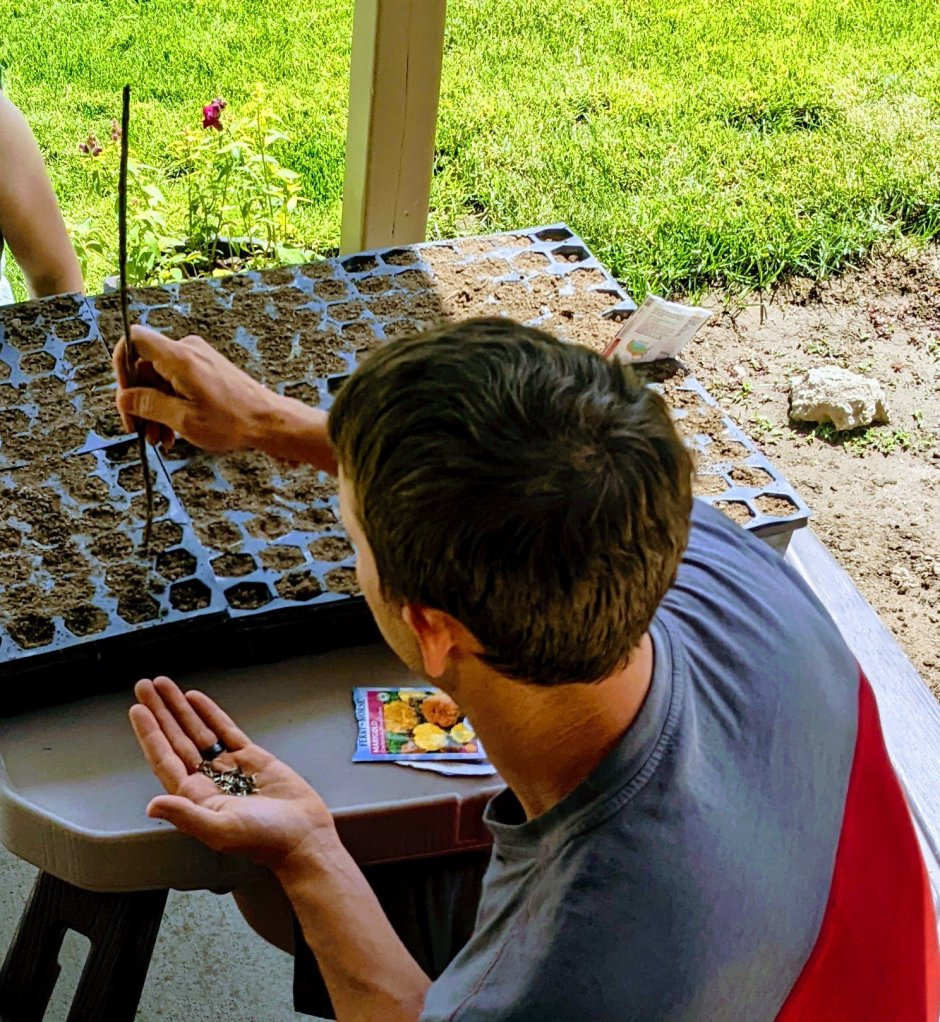
We poked little holes in our soil boxes, and I wasn’t sure how many to put in each hole, or if the sun would be too harsh, or if I’d be faithful to follow up. But I had to try. Humbled at my lack of knowledge, I appreciated the fact I had no control as to whether this tinsey seed would germinate where I attempted to place it. It all seemed like a shot in the dark, but a profound one. Then it occurred to me how biblical the planting process is.

God requires a similar faith in obedience of missional seed planting. I Corinthians 3:5-9–

“What then is Apollos? And what is Paul? Servants through whom you believed, even as the Lord gave opportunity to each one. I planted, Apollos watered, but God was causing the growth.  So then neither the one who plants nor the one who waters is anything, but God who causes the growth. Now he who plants and he who waters are one; but each will receive his own reward according to his own labor. For we are God’s fellow workers; you are God’s field, God’s building.”

As I sprinkle water on the tiny creations I’m caring for, I hope I’ll remember the real seed-planting partnership I’m called to. The Lord graciously gives opportunities to obey and speak the gospel in season and out of season, planting and watering seeds like Paul and Apollos. But God alone will determine the future of each one’s growth. We each will receive our own reward, and it won’t depend on the outcome of the seed’s growth, but on our obedient response in faith.

We may not ever see the results. In Barbara Cooney’s picture book Miss Rumphius, she tells the story of the “Lupine Lady” who cast seeds throughout her town in order to make it a more beautiful place. From her seeds, lupines delighted generations after she was gone. She simply scattered seeds along her pathway.

This summer let’s pray for chances to drop seeds in the gaping holes of emptiness we come across on our own pathways. To have His Word ready on our tongues, to labor in the heat of the desert, to plant where it seems barren. Work with our fellow forgiven workers, understanding the significant insignificance of our actions in the light of God’s sovereignty.

Everywhere we look is the field. At the park, at the thrift store, at the neighborhood bbq, at our front door. As the Lord’s servants, let us not freeze up in overwhelm that it may be too early or too late for planting. Let us not fear if we don’t know the right amount of seeds or the science of the soil. Let us not doubt the seed may be too microscopic to even produce a blossom.

Because God owns the field. We are fellow gardeners with Him, and what a privilege. The time is now to share about His goodness and the need to be saved from sin. There is a peace (and a reward!) in obedience, knowing we plant and water, but God controls the weather, the soil, and the fruit.

Unfiltered Christmas

The eagerness mounted last year as I watched people all over the world bring Christmas to their hearths in golden creams and woodsy sparkle. I couldn’t wait to capture all I had learned about decorating into my first Christmas in a new home.

After Thanksgiving, I sat amidst the Walmart bags and bubblewrap wrapped around my ornaments and nativity set. My collection of childhood ornaments and hand-me-down castaways stared at me, as my vision for coco-bombs and neutral threads met . . . . what I had to work with. How could I make any theme out of mismatched snowmen, a painting of a cardinal, and ornaments chipped from my childhood? My taste in style had changed with the trends, but my decor bin hadn’t.

The feeling of unmet expectation peaked when we pulled out our sparse four-foot tree. What perched cozy and perfect in our apartment, now the most Charlie Brown tree that ever Charlie Browned.

We stood it on a table to keep it from being swallowed in our new space. “It looks like it’s trying to be something it’s not,” my husband pointed out, and then we burst into long laughter. So I made the best of our Christmasy mess and enjoyed it all December.

But I made mental notes for next year.

First, truth be told, I found a much grander tree, and today I decked the thrifted 7.5-footer with strands of red beads. It fills the room with announcement of light and honor brought to our humble ornament-shaped memories.

Secondly, remembering my decorating despair of 2020, I’m choosing to admire the lovely Christmas-card moments on “the ‘Gram,” but also pray a guard of contentment for myself. May I rejoice in my gifts of my own home and my Savior.

Material beauty will never be enough. The best of earth will never meet the deepest longing of our brokenness. We long, like pining Bethlehem, for our Mighty God to do great things for us. And He has.

I see it in the shiny gold letters that spell out the names of Christ, draping our tree. Prince of Peace. Emmanuel. Savior. Mighty God. Wonderful Counselor.

I see it in my little elfish helper, who will fully enjoy his first Christmas if cardboard boxes and people are involved.

I see it in how our Charlie Brown tree from the apartment days (now gracing the back room) reminds me unmet expectations are a mercy because they can set our eyes on God’s wondrous light. Each seasonal disappointment, shattered ornament, or sickness gives another reason to joyfully worship a perfect God who meets all our true needs.

I wish you an unfiltered, real Christmas where real truths, like “veiled in flesh the Godhead see . . . born to give them second birth” are the brightest theme of this season.

“Christ, by highest heav’n adored,
  Christ, the everlasting Lord:
Late in time behold Him come,
  Offspring of a virgin’s womb.
Veiled in flesh the Godhead see,
  Hail th’ incarnate Deity!
Pleased as man with man to dwell,
  Jesus our Immanuel.

Hail the heav’n-born Prince of Peace!
  Hail the Sun of righteousness!
Light and life to all He brings,
  Ris’n with healing in His wings:
Mild He lays His glory by,
  Born that man no more may die;
Born to raise the sons of earth;
  Born to give them second birth.”
“Hark the Harold Angels Sing,” Charles Wesley

Parking Lot Prelude

I’ve been uniquely positioned to see a new angle of behind-the-scenes church since I’ve become a mom. Whether it’s catching most of the sermon from the foyer speakers, inhaling the shared meal before the baby wakes up, or catching conversations over the diaper changing table in the nursery, church looks a bit different in this season. I’ve appreciated the new observations I’ve made. 

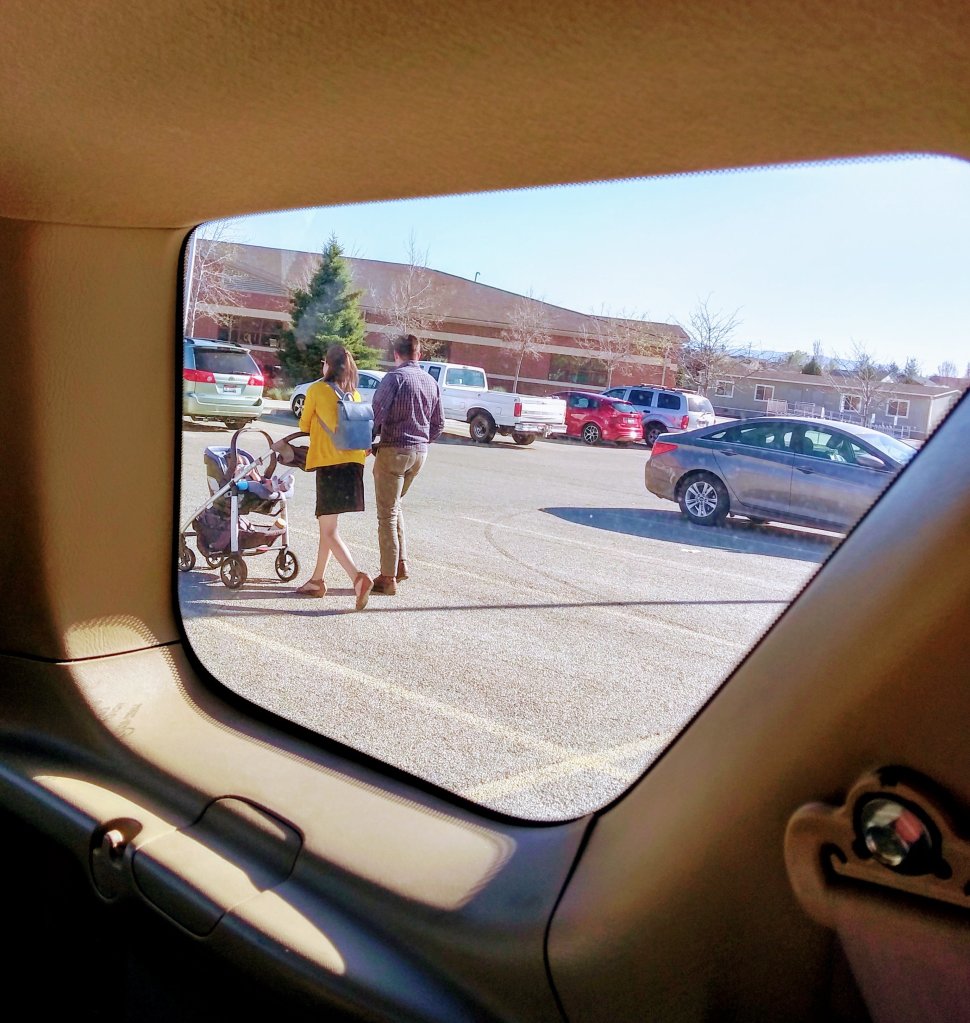
Sunday morning I sat in our car, fitting in a baby feeding before the service started. My husband was greeting at the door, but I had a chance to observe the happening parking lot.

There’s something special about seeing car after car turn into this holy slab of cement. The day washed in sunshine, smiles appeared bright.

I noticed a newlywed couple, dressed in Sunday best, but returning a post hole digger to someone else’s vehicle before heading into the building. 

There also was a darling collection of six young siblings tumbling out of the van, waving to their friends as they patiently waited for their parents. Their pink dresses, blue plaids, and grins melted my heart. “Behold, children are a gift from the Lord.” What a testimony their smiles were to the joy of the Lord! 

A few spaces down, my sister and her husband emerged from their car, with laughter and coffees. They whipped out baby and baby stroller in practiced teamwork style, also eager to worship.

As more people filed toward the front doors, I also noted a new haircut, a young believer in the faith, and a proud, new grandma. The high school seniors had arrived early to pass out their grad party invitations.

Each sister and brother in Christ — young and old — spoke some aspect of God’s truth to me. I need them all.

They are individuals carrying unique spiritual gifts into the church foyer. Members of Christ’s body, and if they are suffering, we all are; if they are rejoicing, we all are, and somehow we can visit both places at once in our Oneness with Christ. The Man of Sorrows and yet, the Dayspring from on High.

What a gift to be physically together. The sun and spring blossoms beckoned praise. I reached for my Bible to read a little, and my eyes fell on this passage:

“Oh come, let us worship and bow down;

    let us kneel before the Lord, our Maker!

For He is our God,

    and we are the people of His pasture,

    and the sheep of His hand.

Today, if you hear His voice,

 do not harden your hearts, as at Meribah,

    as on the day at Massah in the wilderness.”

Psalm 95:6-8

Since I was peering through my vehicle’s tinted windows, and not through rose-colored glasses, I knew this was as an imperfect sheep gathering as any. We desperately need God to soften our prone-to-be-hard hearts to worship Him and genuinely care for one another. We also need each other to call one another to worship and bow down.

My heart swelled as I prepared to set up my own little sheep’s stroller and enter the gates with thanksgiving. I determined to encourage anyone I could and also be encouraged.

The behind-the-scenes of the parking lot gave me a small prelude of thankfulness as I prepared to worship with this gift of grace we call the local church.